
Engineering Portfolio
Full-stack engineering, architecture, reliability and developer tooling.
Published:
Updated:
About Me
I'm a software engineer working primarily with TypeScript across frontend, backend and delivery infrastructure, with experience across SaaS products and large-scale e-commerce platforms. My recent work has spanned both the modernization of a mature legacy codebase and the development of a new multi-market platform from the ground up. This has included reducing technical debt, replacing legacy integrations, strengthening type safety and testing, and evolving application and API architecture, as well as taking ownership of architectural decisions, CI/CD and production delivery.
I remain actively involved in hands-on product development and production engineering today. Below are selected case studies and engineering work covering different parts of this experience.
Restaurant Services SaaS Platform
Technical Lead · Full-Stack Architecture · 2020-2022 · Germany
Selected case study from my earlier full-stack engineering work.
A multi-tenant SaaS platform for restaurants with customer-facing storefronts, restaurant administration, ordering, delivery, payments, geospatial services and platform-level administration.
I worked as the technical lead across frontend and backend architecture, database design, CI/CD, deployment workflows and developer support.
Selected technologies: TypeScript, React, Node.js, Next JS, Django, PostgreSQL, PostGIS, Docker, Stripe, PayPal, OAuth 2.0, Google Maps APIs, CI/CD
Project Overview
The platform supported restaurant-specific storefronts as well as a central marketplace. Restaurants could also connect custom domains.
Core functionality included:
- restaurant discovery and filtering
- custom restaurant domains
- customer accounts, carts and checkout
- configurable products and toppings
- delivery areas and scheduling
- Stripe and PayPal payments
- restaurant tariffs and billing
- platform and restaurant administration
- PDF billing documents

Multi-Tenant Architecture
Tenant isolation was one of the main architectural requirements.
Requests to restaurant domains were resolved to a tenant context before API operations. Restaurant data remained tenant-scoped, while the central marketplace supported authorized cross-restaurant customer features such as orders, carts, vouchers and favourites.
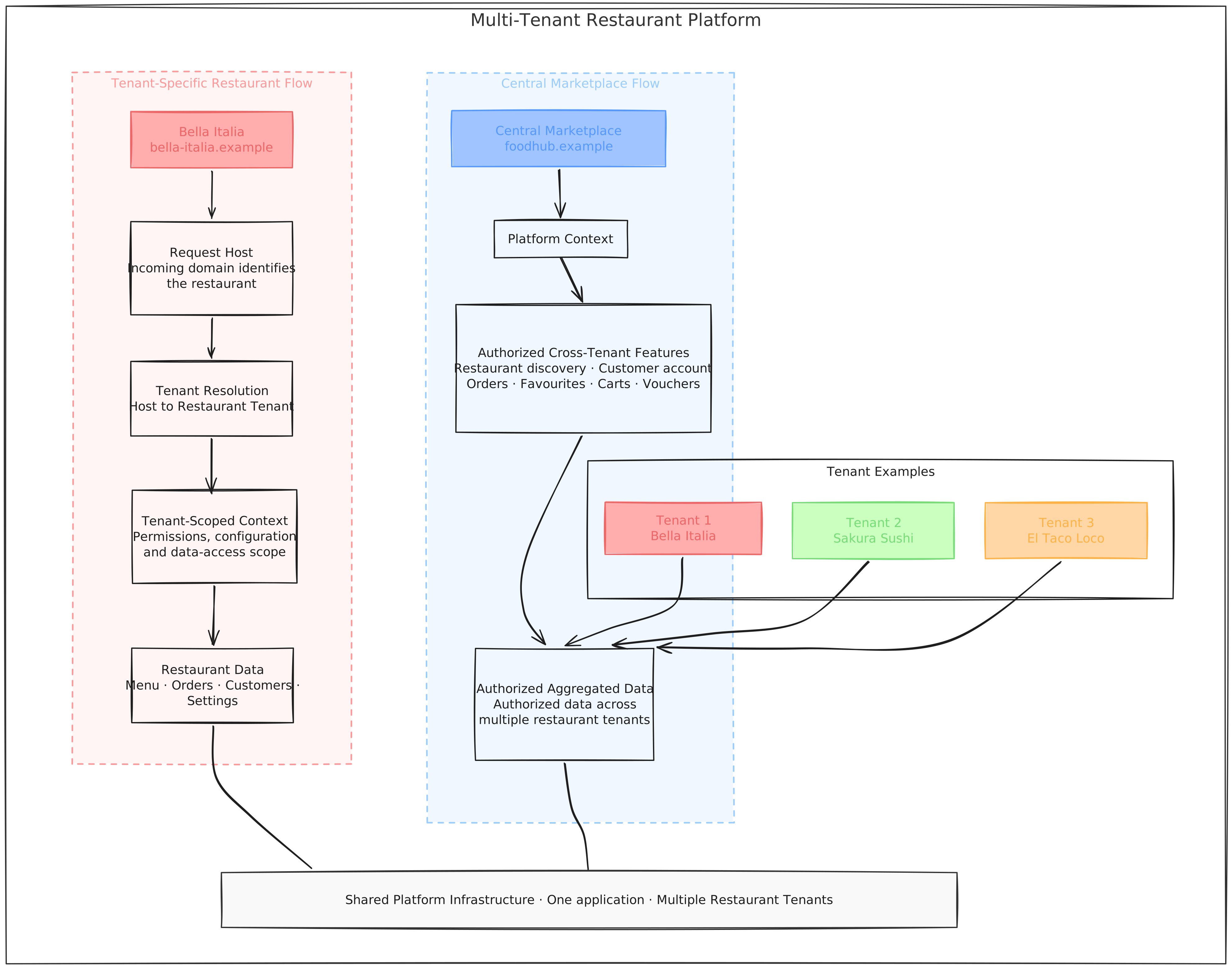
Authorization and role-based permissions provided an additional boundary for restricted operations.


Product Domain Modelling
Restaurant products required more than a single product-price model.
The model supported:
- sizes and variants with different prices
- topping groups
- variant-dependent topping prices
- configurable free topping allowances
- optional and required selections
- categories and subcategories

A separate administration interface allowed restaurant staff to manage these structures without database-level changes.
Tenant-Level Order Management
Each restaurant operated as an independent tenant with access to its own operational and financial data. The restaurant administration interface provided a dedicated view of orders, including payment amounts, platform fees, taxes, and the resulting earnings for each transaction.

The platform also supported a subscription-based model, with different plans defining the services and commercial conditions available to restaurants.
Geospatial Delivery Logic
PostgreSQL with PostGIS was used for restaurant locations and delivery geometry. Google Maps and geocoding APIs supported:
- restaurant location management
- delivery-area configuration
- address geocoding
- delivery eligibility
- map-based administration

Date, Payments and Billing
Time-sensitive functionality included:
- opening and delivery times
- scheduled orders and prioritisation
- subscription and billing periods
- monthly receipts and reporting
Timestamps were stored consistently while German business-time rules were applied where required.
External integrations included:
- Stripe with 3D Secure
- PayPal
- Google Maps and geocoding
- PDF generation
Restaurant plans, billing periods, statistics and receipt generation were configurable through the platform.
Menu Structure Management in Administration
Administrative functionality included drag-and-drop ordering of categories, subcategories and products.

MENU STRUCTURE MANAGEMENT

┌──────────── Django Admin ───────────┐        ┌──── Restaurant Storefront ─────┐
│                                     │        │  trattoria-verde.example       │
│  Categories                         │        │                                │
│                                     │        │  BREAKFAST  PIZZA  STARTERS    │
│  ↕ Breakfasts                       │   →    │  DESSERTS   BEVERAGES          │
│  ↕ Pizza                            │        │  ────────────────────────────  │
│      ↕ Homemade                     │        │                                │
│         Margherita                  │        │          [ food hero ]         │
│         Carbonara                   │        │                                │
│      ↕ Vegan Pizzas                 │        │  HOMEMADE   VEGAN PIZZAS       │
│         Vegetable Pizza             │   →    │  ────────────────────────────  │
│  ↕ Starters                         │        │                                │
│  ↕ Desserts                         │        │  Margherita        €11.25      │
│  ↕ Beverages                        │        │  Carbonara           €9.65     │
│                                     │        │                                │
└─────────────────────────────────────┘        └────────────────────────────────┘
              │                                           ▲
              └──────────── persisted ordering ───────────┘

      Drag & drop hierarchy              Tenant-specific menu rendering

      Categories  ─────────────────────→ top navigation
      Subcategories ───────────────────→ menu sections
      Products ────────────────────────→ ordered product lists
Security
Security-related work included:
- strict tenant isolation
- role-based permissions
- protected administrative operations
- CSRF protection for state-changing form submissions
- authentication-state handling
- CORS and cookie configuration
- payment-related security constraints
Access restrictions were enforced beyond the frontend UI and before sensitive data operations.
Deployment and Operations
The application ran in Docker- and Kubernetes-based infrastructure. Kubernetes provisioning and cluster configuration were handled by DevOps; I worked with the deployed environments as part of day-to-day development and maintenance.
                    ┌────────────────────────────────────┐
     DevOps ·······>│   Kubernetes-based infrastructure  │
     cluster        │                                    │
     provisioning   │   ┌─────┐ ┌─────────┐ ┌────────┐   │
                    │   │ DEV │ │ STAGING │ │  PROD  │   │
                    │   └─────┘ └─────────┘ └────────┘   │
                    │                 ↑                  │
                    │                 │ restore          │
                    │          ┌──────────────┐          │
                    │          │   Database   │          │
                    │          └──────┬───────┘          │
                    │                 │ dump             │
                    │          ┌──────▼───────┐          │
                    │          │ Backup / Dump│          │
                    │          └──────────────┘          │
                    └────────────────────────────────────┘
                          ↑        ↑          ↑
                          │        │          │
                       deploy   rollback   troubleshoot
                          │        │          │
                    ┌─────────────────────────────────┐
                    │ MY OPERATIONAL RESPONSIBILITIES │
                    │                                 │
                    │ • deployments                   │
                    │ • rollbacks                     │
                    │ • file transfers                │
                    │ • database dumps                │
                    │ • test environment restores     │
                    │ • deployed-app debugging        │
                    └─────────────────────────────────┘
Testing
Testing included:
- unit testing of application and domain logic
- acceptance testing of user-facing workflows
- verification of backend and frontend behaviour across core restaurant operations
Architecture Trade-Offs
The platform was built as a monolith. This kept development and deployment manageable for a small team, but coupling increased as ordering, billing, delivery, payments and administration grew.
If redesigning it today, I would keep the operational simplicity of a monolith initially but define clearer internal domain boundaries. Services would be extracted only where independent scaling, reliability or deployment requirements justified it.
Technical Leadership
My responsibilities included:
- frontend and backend architecture
- database design
- CI/CD and deployment workflows
- technical decisions and feature decomposition
- implementation and maintenance
- supporting less experienced developers
Full-Stack Architecture & Deployment
Independent Project · Full-Stack Engineering · 2022-2024
Full-stack system design, deployment and operational ownership.
I designed, developed, deployed and operated a personal full-stack application across the frontend, backend and infrastructure layers.
The system combined a React frontend with a Node.js GraphQL backend, ArangoDB and Redis Streams for asynchronous message queues and event processing. The backend used command-driven use cases, dependency injection, repositories and application events, with an architecture influenced by ports-and-adapters patterns.
Beyond application development, I built and maintained the deployment path myself: Dockerized services, Nginx configuration, DigitalOcean infrastructure, GitHub Actions CI/CD, database backups and recovery procedures.
Selected technologies: TypeScript, React, Node.js, GraphQL, ArangoDB, Redis Streams, Docker, Nginx, DigitalOcean, GitHub Actions
Engineering focus: Full-Stack Architecture · System Design · DevOps Mindset · Operational Ownership
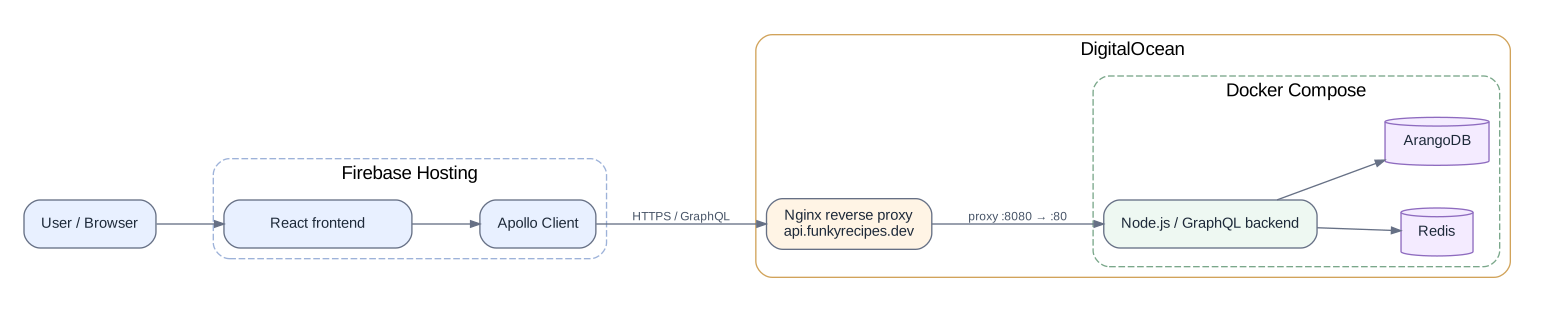
The project gave me hands-on experience with the concerns that appear once an application leaves local development: deployment automation, service configuration, persistence, infrastructure boundaries, backups and recovery.
→ Read the full Engineering Lab case study
Reliability & E2E Engineering
E2E Engineering · 2023-2026 · Professional Work
E2E automation since 2023, with dedicated ownership of test architecture and maintenance from 2025.
E2E Suite Ownership
From 2025, I became the primary engineer responsible for an existing E2E suite that had been largely abandoned after its initial implementation.
I inherited roughly 70-80 legacy tests with obsolete scenarios, duplicated market-specific coverage, unreliable selectors and synchronization issues. Rather than expanding the existing structure, I gradually redesigned the suite around reusable Playwright tests and configuration-driven execution.
My work included:
- reviewing and restructuring legacy tests
- removing obsolete scenarios and repairing business-critical coverage
- migrating Cypress tests to Playwright
- introducing stable
data-testidselectors - replacing arbitrary waits with explicit synchronization
- building reusable helpers and fixtures
- replacing market-specific test duplication with tag-based execution
- supporting multiple environments, locales and B2B/B2C configurations
- integrating execution and reporting into CI/CD
- investigating flaky failures across UI, network and application state
The suite has since grown from roughly 70-80 inherited tests to around 300 maintainable E2E scenarios. Many of these scenarios are reused across different markets and configurations rather than duplicated into separate market-specific test suites.
CI/CD and Execution
The migration was not a one-to-one Cypress rewrite. Test architecture, execution strategy and CI integration were redesigned together.
Parallel Playwright execution reduced a representative CI run from approximately 13.5 minutes to around 6-7 minutes while the overall coverage continued to grow.
The suite is now also executed on a daily schedule, providing continuous regression feedback rather than relying only on occasional manual execution.
CI coverage spans:
- locales and regional behaviour
- B2B and B2C flows
- authentication and logout
- checkout and payment flows
- consent-dependent behaviour
- external integrations
- error and rejected-operation paths
Tests are distributed across separate CI jobs for different markets and configurations. As a result, the approximately 300 logical test scenarios can produce substantially more individual test executions across the full CI matrix.
API Contract Testing
In addition to browser-level E2E coverage, I introduced contract tests that validate API responses against expected schemas.
This provides a separate signal for API and test-data inconsistencies and helps distinguish application regressions from failures caused by unstable environment or staging data.
Together, the E2E and contract-test pipelines regularly surface regressions, integration problems and data inconsistencies during ongoing development, including issues that could otherwise reach production.
Impact & Scale
- ~70-80 inherited legacy E2E tests → ~300 maintainable scenarios
- ~13.5 min → ~6-7 min for a representative parallelized CI run
- daily scheduled regression execution
- reusable tag-based coverage across markets instead of duplicating entire suites
- multiple market, locale, environment and B2B/B2C configurations
- browser-level E2E coverage complemented by API contract validation
Secure Upload & Checkout Architecture
Independent Project · Full-Stack Engineering · 2026 · Lok Chan Art
Selected case study from a larger production application. This section focuses on the secure upload and checkout architecture.
I designed and implemented the upload and checkout workflow for custom portrait commissions on Lok Chan Art.
The main requirement was to accept relatively large customer images without proxying file bytes through the application backend, while keeping storage access restricted.
Upload Architecture
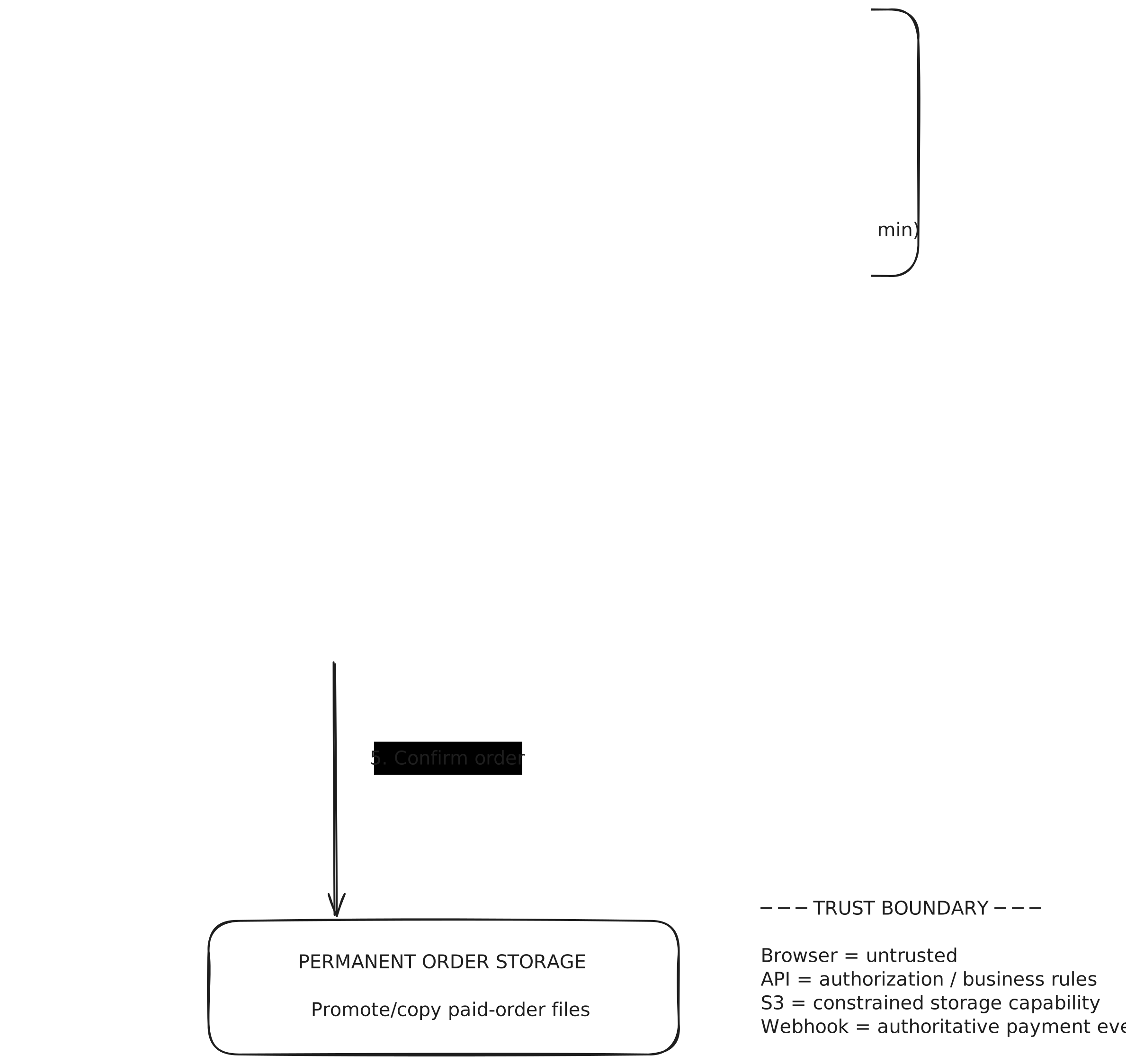
→ Open architecture diagram in Excalidraw
Direct Upload with Short-Lived Authorization
The backend authorizes uploads but does not proxy the image itself. The browser uploads directly to object storage using temporary server-issued authorization.
Upload authorization is short-lived — approximately two minutes — and a new token is requested when required instead of keeping a long-lived upload credential in client state.
This avoids an unnecessary binary-data hop through the application server while keeping storage operations controlled by backend authorization.
Upload Guardrails
The flow combines:
- maximum file size and file-count limits
- allowed MIME types and file validation
- short-lived authorization
- restricted storage operations
- CORS restrictions
- rate limiting
- temporary draft storage
- automatic expiration of abandoned uploads
- separation of temporary and permanent order files
Uploaded customer files are treated as untrusted input, and security-sensitive restrictions do not rely only on client-side validation.
Temporary Storage and Checkout
Uploads begin as temporary drafts. Abandoned uploads expire instead of remaining as permanent assets.
After successful checkout, a server-side payment webhook triggers order processing and promotion of the required files to permanent order storage.
The browser is therefore not treated as the authoritative source of payment completion.
Security Model
The upload flow uses layered controls rather than a single security mechanism:
Request Validation
       ↓
Rate Limiting
       ↓
Short-Lived Authorization
       ↓
File / Storage Restrictions
       ↓
Temporary Lifecycle
       ↓
Server-Side Payment Confirmation
       ↓
Permanent Order Storage
This case study covers one part of a larger production application. The project overview explores the broader architecture, transactional email, internationalization, SEO and performance, and links to a detailed case study of the production domain migration.
Explore the engineering behind Lok Chan Art →
Dev Content Automation
Personal Project · Developer Tooling · 2026 · In progress
I started building dev-content-automation for myself to make it easier to turn
engineering work into posts. The idea is to bring my notes, selected code excerpts,
and diagrams together in a draft I can review and edit.
The current tool runs locally and uses templates to prepare an MDX article, a LinkedIn draft, and supporting visuals. It records source references so I can trace the excerpts back to the code. I choose the material, write the explanations, and review the result before publishing.
Technologies: TypeScript, Node.js, Zod, MDX, Mermaid.

The pipeline is now used to prepare articles for the Engineering Lab. It gathers evidence from the underlying projects and repositories, traces relationships between files and architectural components, and uses those findings to prepare structured drafts and supporting materials for author review.
The articles currently published in the Engineering Lab were prepared with this workflow and then reviewed and edited before publication.
Explore the Engineering Lab →
Engineering Beyond the Frontend
My work regularly extends beyond UI implementation.
Frontend & application: TypeScript, React, Next.js, localization, complex state and user flows
Backend & data: Node.js, APIs, GraphQL, PostgreSQL, ArangoDB, PostGIS, Redis, authentication and authorization, access and refresh token handling
Integrations: OAuth 2.0 / Google authentication, payments, webhooks, Google Maps and geocoding APIs, AWS S3 object storage
Delivery & reliability: Docker, Kubernetes-based environments, CI/CD, E2E automation, production debugging
I am comfortable working across browser, API, database and external-service boundaries while keeping ownership boundaries explicit — for example, using Kubernetes-based infrastructure without claiming responsibility for cluster provisioning.
AI-Assisted Engineering
I use coding agents for implementation, exploration, refactoring and debugging, with the same review standards I apply to manually written code.
My workflow typically includes:
- providing architecture, types, constraints and expected behaviour as context
- reviewing generated changes for incorrect assumptions and unnecessary complexity
- checking edge cases, type safety, error handling and security implications
- validating changes with static analysis and automated tests
- keeping architectural and delivery decisions under human ownership
AI-assisted development increases implementation speed, but generated output is still treated as code that must be understood and verified.